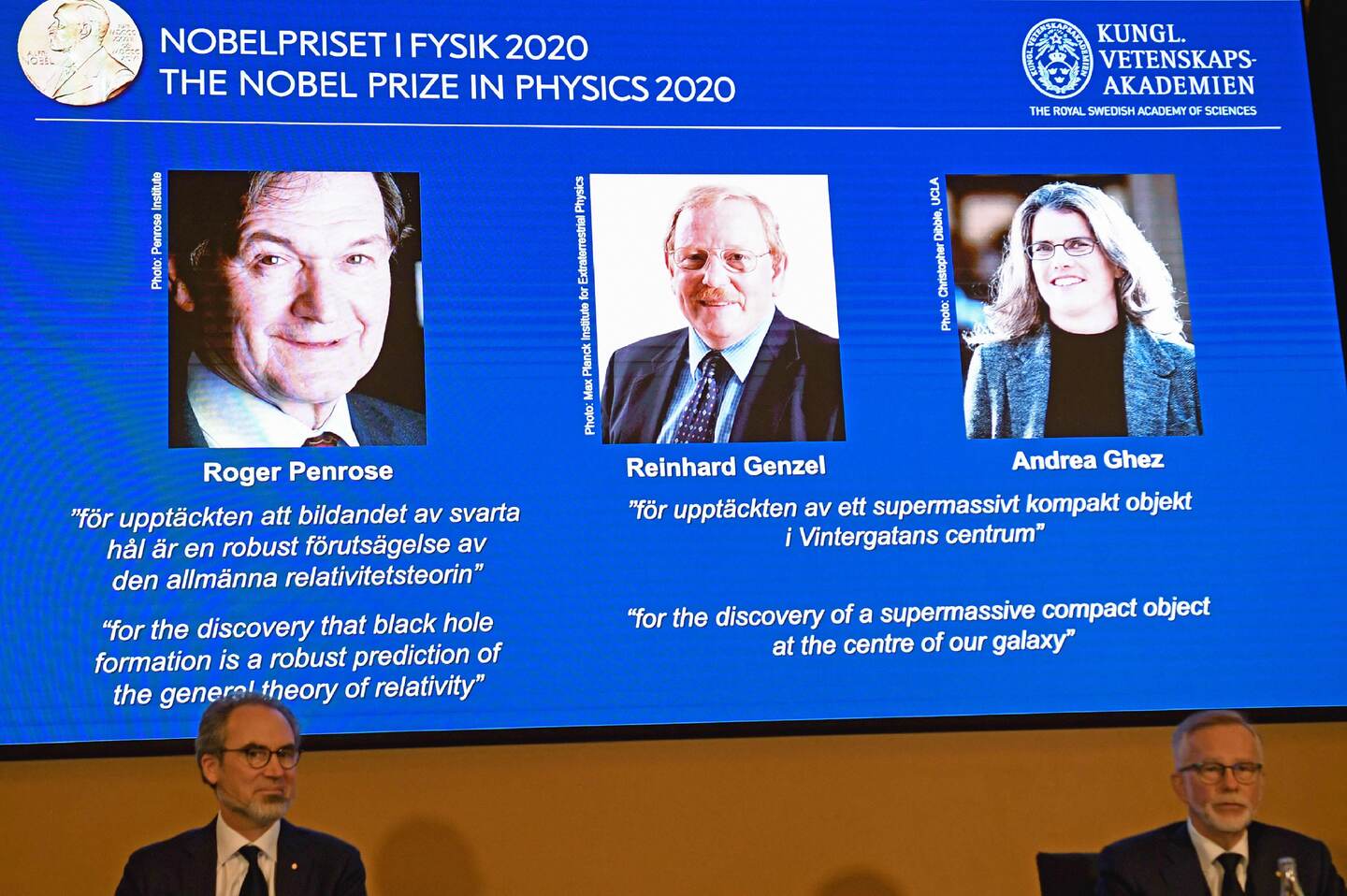
La mitad del premio recayó en Penrose, de 89 años, por demostrar “que la formación de un agujero negro es una predicción sólida de la teoría de la relatividad general” y la otra mitad se la reparten Genzel, de 68, y Ghez, de 55, por descubrir “un objeto compacto y extremadamente pesado en el centro de nuestra galaxia”, explicó el jurado.
Ghez es la cuarta mujer que gana un Nobel de Física, el más masculino de los seis prestigiosos galardones, una distinción que la científica dijo tomarse “muy en serio”.
LEA MÁS: Científicos descubren la mayor fusión de dos agujeros negros observada hasta ahora
“Estoy encantada de poder servir de modelo para las mujeres jóvenes que se plantean ir hacia este ámbito”, afirmó Ghez a la AFP.
Aunque a muchos nos fascinan, “muy pocas personas entienden lo que es un agujero negro”, reconoce la astrónoma, basada en California. “Las leyes de la física cerca de un agujero negro son tan diferentes de las que operan en la Tierra”, es “muy difícil de conceptualizar”, dijo.
Cercano a Stephen Hawking
Penrose ha utilizado desde 1965 la matemática para probar que los agujeros negros pueden formarse y convertirse en una entidad de la que nada, ni siquiera la luz, puede escapar. Sus cálculos demostraron que son una consecuencia directa de la teoría de la relatividad general de Einstein.
El científico británico era cercano a su célebre compatriota astrofísico Stephen Hawking, fallecido en 2018. Un Nobel para él habría sido “bien merecido”, reconoció el profesor en una rueda de prensa.
Juntos “probaron matemáticamente que cuando una estrella muy masiva colapsa, termina en agujero negro”, explicó a la AFP Luc Blanchet, del Instituto de Astrofísica de París.
Desde los años 90, Genzel y Ghez han investigado conjuntamente el centro de la Vía Láctea, donde comprobaron la existencia de un agujero negro supermasivo, bautizado Sagitario A*.
Utilizando los mayores telescopios para estudiar las órbitas de las estrellas cercanas, comprobaron matemáticamente mediante la atracción gravitacional la existencia de un objeto invisible y con una masa equivalente a unos cuatro millones de veces la del sol.
“El secreto más oscuro de la Vía Láctea”, aclamó el jurado. La canciller alemana Angela Merkel, a través de su vocero, expresó su “gran agradecimiento” a su compatriota Genzel por su “trabajo pionero”.
(Video) El Nobel de Física premia a tres expertos de los agujeros negros
En el Instituto Max Planck de Física Extraterrestre (MPE), Genzel dijo haber derramado “algunas lágrimas”, pensando que debía esperar muchos años para la distinción. “Una de las cualidades que un investigador necesita para ganar un Nobel es vivir mucho”, bromeó.
Los agujeros negros supermasivos son un enigma de la astrofísica, sobre todo por la manera en que llegan a ser tan grandes, y su formación centra muchas investigaciones. Los científicos piensan que devoran, a una velocidad inaudita, todos los gases interestelares que les rodean.
Una primera imagen revolucionaria de estos fenómenos cósmicos fue revelada al mundo en abril de 2019, por un equipo internacional del Event Horizon Telescope, que registro las radiaciones emitidas por el disco de acreción que rodea al agujero negro en el centro de la Galaxia M87, a más de 50 millones de años luz de la Tierra.
“Es la edad de oro para la investigación sobre los agujeros negros, con maravillar que van a llegar”, declaró a AFP Shep Doeleman, director del proyecto.
Un millón de euros
En el 2019, el Nobel de Física fue para tres cosmólogos, el canadiense-estadounidense James Peebles, que siguió los pasos de Einstein para aclarar los orígenes del universo, y los suizos Michel Mayor y Didier Queloz, quienes revelaron la existencia de un planeta fuera del sistema solar.
LEA MÁS: Científicos se preparan para mostrar la primera foto de un agujero negro
Los Nobel se están anunciando esta semana como estaba previsto, pero el nuevo coronavirus hizo cancelar la ceremonia de entrega de los premios el 10 de diciembre en Estocolmo.
Los galardonados, que se reparten cerca de un millón de euros ($1,1 millones) por cada disciplina, recibirán el premio en su país de residencia.
El lunes, el de Medicina confirmó la superioridad de los estadounidenses en el palmarés de las disciplinas científicas al recaer en Harvey Alter y Charles Rice, con el británico Michael Houghton, por su papel en el descubrimiento del virus causante de la hepatitis C.
Le seguirá el miércoles el de Química y el jueves el premio de Literatura, el más esperado junto con el de la Paz, que se conocerá el viernes en Oslo. Y finalmente el de Economía el lunes.