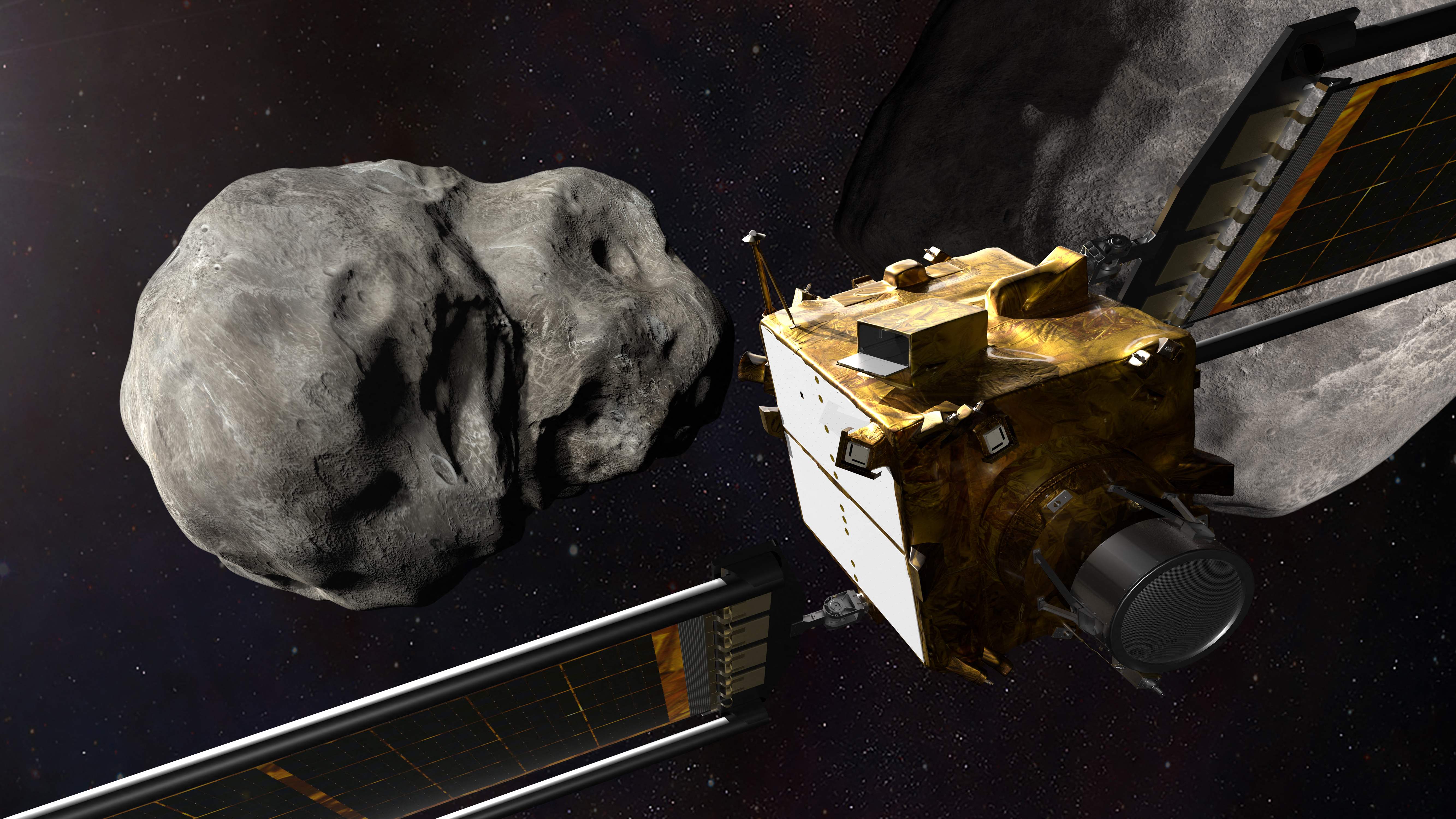
La NASA intentará el lunes una hazaña que la humanidad nunca antes ha logrado: estrellar deliberadamente una nave espacial contra un asteroide para desviar ligeramente su órbita, una prueba clave para demostrar la capacidad de evitar que los objetos cósmicos destruyan la vida en la Tierra.
La misión DART (Double Asteroid Redirection Test) se lanzó desde California en noviembre y se acerca rápidamente a su objetivo, al que impactará a unos 23.000 kilómetros por hora.
Para que sea seguro, ni el asteroide Dydimos ni Dimorphos, el pequeño asteroide que lo orbita, representan una amenaza, ya que ambos giran alrededor del Sol, pasando a miles de millones de kilómetros de la Tierra. Pero este experimento es considerado importante por la NASA, que quiere realizarlo antes de que exista una necesidad real.
"Es un momento emocionante, no solo para la agencia, sino también para la historia espacial y la historia de la humanidad", dijo Lindley Johnson, oficial de defensa planetaria de la NASA, en una sesión informativa el jueves.
La NASA impactará un asteroide en una prueba de defensa de la Tierra
Si todo sale según lo planeado, el impacto entre la nave espacial -del tamaño de un automóvil- y el asteroide de 160 metros -equivalente a dos Estatuas de la Libertad- tendrá lugar a las 5:14 p. m. (hora de Costa Rica) del lunes y se podrá seguir en una transmisión en vivo de la NASA.
Al impactar de frente contra Dimorphos, la NASA espera empujarlo a una órbita menor, reduciendo diez minutos el tiempo que tarda en circunvalar a Didymos, actualmente de 11 horas y 55 minutos, un cambio que será detectado por los telescopios terrestres en los días siguientes.
El experimento hará realidad algo solo realizado en la ciencia ficción, en particular en películas como Armageddon y Don’t Look Up.
A medida que la nave avanza por el espacio, de forma autónoma en la fase final de la misión, como un misil autoguiado, su sistema de cámara principal, llamado DRACO, comenzará a transmitir las primeras imágenes de Dimorphos.
"Comenzará como un pequeño punto de luz y, finalmente, se ampliará y llenará todo el campo visual", dijo Nancy Chabot, del Laboratorio de Física Aplicada (APL) de Johns Hopkins, que alberga el control de la misión.
Minutos más tarde, un satélite del tamaño de una tostadora llamado LICIACube, que se separó de DART hace un par de semanas, pasará cerca del sitio para capturar imágenes de la colisión y de la roca pulverizada arrojada por el impacto.
Las tomas de LICIACube serán enviadas de vuelta en las semanas y meses siguientes.
También habrá una serie de telescopios, tanto en la Tierra como en el espacio, observando el evento, entre ellos el James Webb, el más potente y recientemente puesto en órbita.
Finalmente, se revelará una imagen completa del sistema cuando una misión de la Agencia Espacial Europea llamada Hera llegue dentro de cuatro años para estudiar la superficie de Dimorphos para medir su masa, algo que los científicos solo pueden adivinar actualmente.
Muy pocos de los miles de millones de asteroides y cometas que se encuentran en el sistema solar se consideran potencialmente peligrosos para la Tierra, y ninguno en los próximos cien años.
Pero "les aseguro que si esperan lo suficiente, habrá uno", dijo Thomas Zurbuchen, científico jefe de la NASA.
Eso se sabe por el registro geológico. Por ejemplo, el asteroide Chicxulub de casi diez kilómetros de ancho golpeó la Tierra hace 66 millones de años, sumiendo al mundo en un largo invierno que llevó a la extinción de los dinosaurios junto con el 75% de las especies.
Un asteroide del tamaño de Dimorphos, por el contrario, solo causaría un impacto regional, como devastar una ciudad, aunque con una fuerza mayor que cualquier bomba nuclear lanzada hasta ahora.
Los científicos también esperan obtener información nueva y valiosa sobre la naturaleza de los asteroides en general.
La cantidad de movimiento que DART genere sobre Dimorphos dependerá de si el asteroide es roca sólida o un "montón de basura" de rocas unidas por gravedad mutua, una propiedad que aún no se conoce.
Tampoco se sabe su forma real: si es más como un hueso de perro o una rosquilla, pero los ingenieros de la NASA confían en que el sistema de guía SmartNav de DART dará en el blanco.
Si falla, la NASA tendrá otra oportunidad dentro de dos años, pues la nave espacial contiene suficiente combustible para otro intento.
Pero si tiene éxito, entonces será un primer paso para que el mundo sea capaz de defenderse de una futura amenaza existencial, dijo Chabot.