Estos son los principales puntos del informe de la OEA que presionó a Evo Morales para convocar nuevos comicios
Grupo de auditores describe irregularidades en el elección general del 20 de octubre, por lo que recomienda que ‘deben ser anulada’
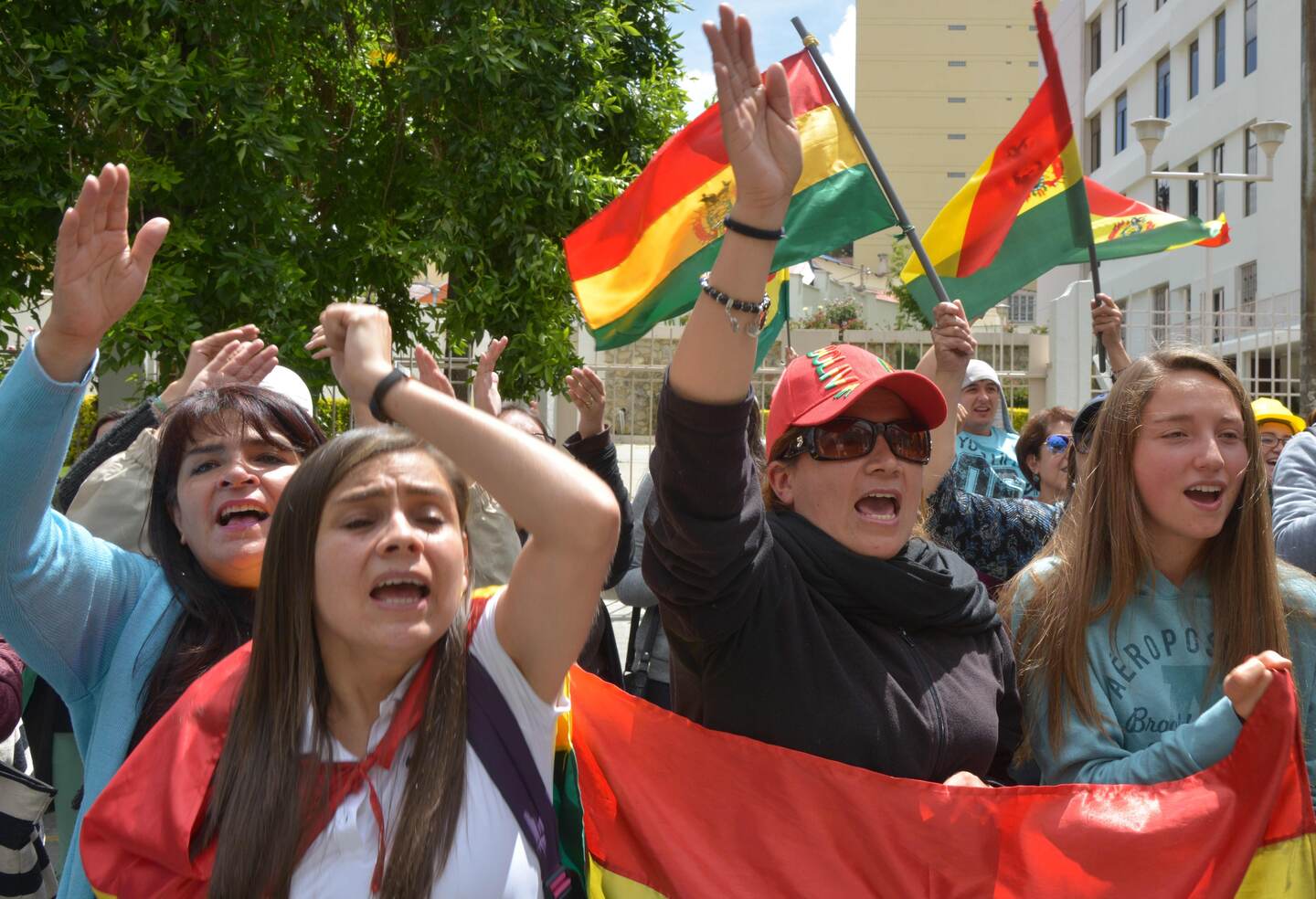
Anti-government protesters show their support to the police outside the Police headquarters after it was announced that the General Attorney's Office of Bolivia has opened an investigation into the seven members of the Supreme Electoral Tribunal for serious irregularities found by an OAS audit in the election count, in La Paz on November 10, 2019. - opposition leaders had accused the Supreme Electoral Tribunal of rigging the count in the October 20 elections in favour of President Evo Morales. The Bolivian leader announced Sunday he was calling fresh elections after the OAS audit. (Photo by Aizar RALDES / AFP) AIZAR RALDES
AFP
Manifestantes opositores muestran su apoyo a la Policía fuera de una sede policial después de que se anunció que la Fiscalía abrió una investigación contra los siete miembros del Tribunal Supremo Electoral por irregularidades graves encontradas en una auditoría de la OEA durante el recuento electoral, en La Paz, el 10 de noviembre del 2019. Foto: AFP (AIZAR RALDES/AFP)
El informe de la auditoría realizada por la OEA sobre la elección general en Bolivia el 20 de octubre describe irregularidades por las que recomienda que “debe ser anulada” y convocar a nuevos comicios “confiables”, con un órgano electoral de “nueva composición”.
El conteo final del Tribunal Supremo Electoral (TSE) atribuyó a Morales un 47,08% de los votos y al opositor Carlos Mesa el 36,51%, con una diferencia mayor al 10%, que le dio al mandatario el triunfo en primera vuelta, habilitándolo para un cuarto mandato hasta el 2025.
Estas son las principales conclusiones de la auditoría de la OEA:
“El equipo auditor no puede validar los resultados de la presente elección, por lo que se recomienda otro proceso electoral. Cualquier futuro proceso deberá contar con nuevas autoridades electorales para poder llevar a cabo comicios confiables”.
“La primera ronda de las elecciones celebrada el 20 de octubre pasado debe ser anulada y el proceso electoral debe comenzar nuevamente, efectuándose la primera ronda tan pronto existan nuevas condiciones que den nuevas garantías para su celebración, entre ellas una nueva composición del órgano electoral”.
“En los cuatro elementos revisados (tecnología, cadena de custodia, integridad de las actas y proyecciones estadísticas) se encontraron irregularidades, que varían desde muy graves hasta indicativas. Esto lleva al equipo técnico auditor a cuestionar la integridad de los resultados de la elección del 20 de octubre pasado”.
“Teniendo en cuenta las proyecciones estadísticas, resulta posible que el candidato Morales haya quedado en primer lugar y el candidato Mesa en segundo. Sin embargo, resulta improbable estadísticamente que Morales haya obtenido el 10% de diferencia para evitar una segunda vuelta”.
“Las manipulaciones al sistema informático son de tal magnitud que deben ser profundamente investigadas por parte del Estado boliviano para llegar al fondo y deslindar las responsabilidades de este caso grave”.
“La existencia de 1.575 actas TREP (sistema de conteo rápido, NDR) en el cómputo final, corresponde a un aproximado de 350 mil votos. El margen de victoria en primera vuelta es menor a 40 mil votos. Por lo tanto, una irregularidad de estas dimensiones es determinante para el resultado. Por estas razones el equipo auditor no puede validar una victoria en primera vuelta”.
“En el último 5% del cómputo, 290.402 votos fueron contabilizados. De estos, Morales ganó 175.670, es decir un 60,5% de los votos, mientras Mesa obtuvo solamente 69.199 votos es decir un 23.8%. En otras palabras, en el último 5% de votación, Morales incrementa el promedio de votación en un 15% comparado con el 95% anterior, mientras Mesa cae en una proporción prácticamente igual. Este comportamiento es muy inusual”.
“La existencia de actas físicas con alteraciones y firmas falsificadas también impacta la integridad del cómputo oficial”.