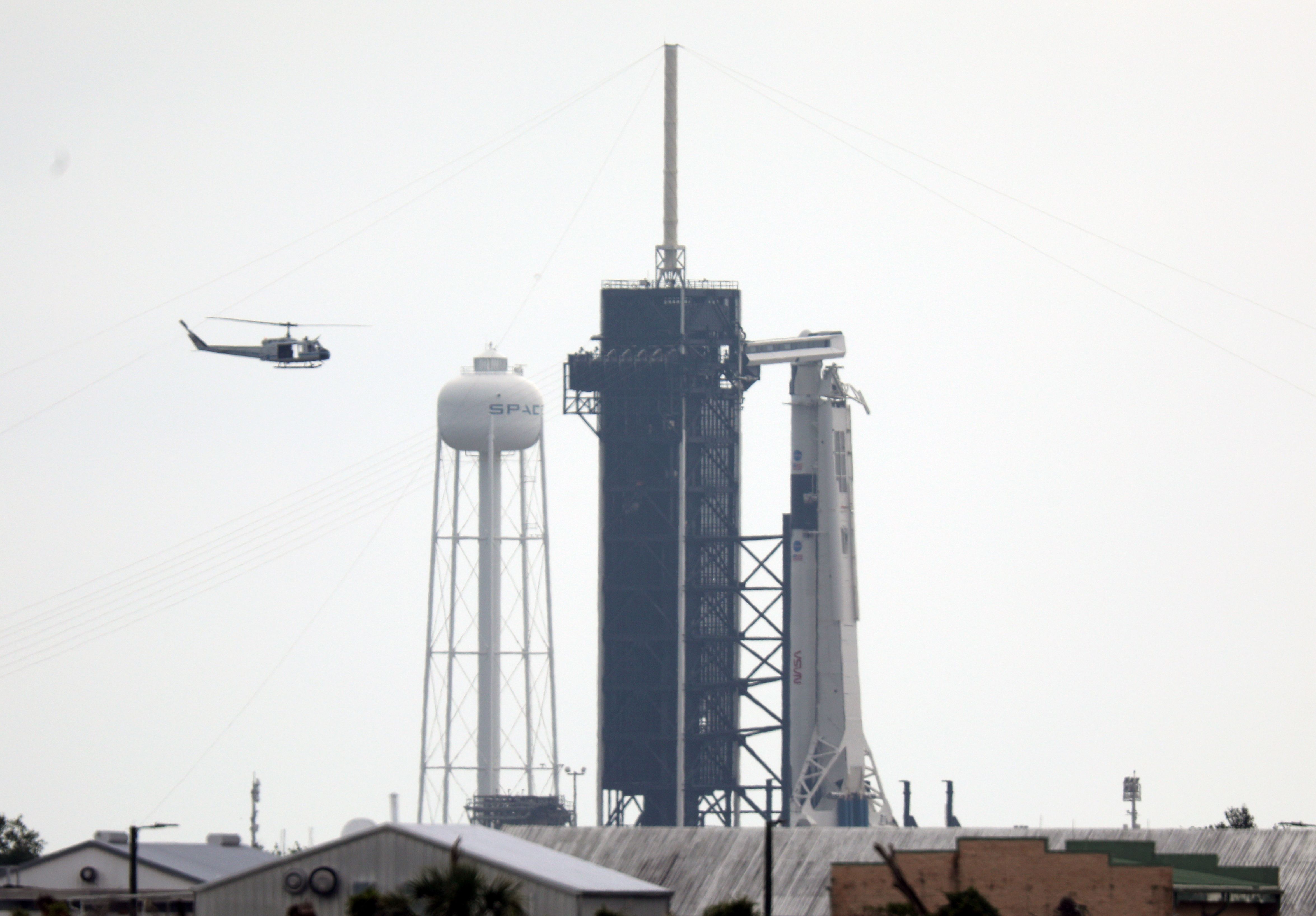
NASA security helicopter flies past launch complex 39A and the SpaceX Falcon 9 rocket with Crew Dragon vehicle on launch day at the Kennedy Space Center in Florida on May 26, 2020. - A new era in space begins Wednesday with the launch by SpaceX of two NASA astronauts into space, a capability that for six decades symbolized the power of a handful of states, and which the United States itself had been deprived of for nine years.If the bad weather clears, at 4:33 pm (20:33 GMT) a SpaceX rocket with the new Crew Dragon capsule on top will take off from Launch Pad 39A at the Kennedy Space Center, the same from which Neil Armstrong and his Apollo crewmates left for their historic journey to the Moon. (Photo by Gregg Newton / Gregg Newton / AFP) GREGG NEWTON
SpaceX intentó lanzar dos astronautas estadounidenses hacia la Estación Espacial Internacional (ISS, por sus siglas en inglés) este miércoles, en lo que se iba a convertir en un hito en la exploración espacial: por primera vez la NASA contrata un viaje fuera del planeta de dos miembros de su equipo a una empresa privada.
SpaceX es una empresa propiedad de Elon Musk, el mismo emprendedor estadounidense detrás de los populares autos eléctricos Tesla. Tras años de pruebas, una de las cuales incluyó un lanzamiento con un maniquí, el lanzamiento programado para las 2:33 p. m. de este 27 de mayo, hora de Costa Rica, tuvo que ser pospuesto.
Además, el lanzamiento implicaba el regreso de las salidas hacia el espacio desde el territorio estadounidense. Desde el final de la era de los transbordadores, hace casi una década, la NASA ha dependido de las cápsulas Soyuz para volar, desde Rusia, hacia la ISS.
Otros millonarios, como Jeff Bezos, dueño de Amazon, y Richard Branson, del grupo Virgin, también trabajan para convertir los viajes espaciales en un negocio que permitiría poner en órbita no solo a astronautas profesionales, sino también a turistas dispuestos a pagar los miles de dólares que cueste un boleto. A mediano plazo, vislumbran un futuro con una estación espacial comercial y una base permanente en la Luna. Un paso importante para llegar a esa meta se daba este miércoles.
El próximo intento de lanzamiento está previsto para el sábado 30 de mayo.
Esta fue la señal en vivo del canal de SpaceX (si tiene algún problema, este es el link):
La brazo que permitió a los astronautas ingresar a la cápsula Dragon se ha retirado:
Si hubiese algún problema en el lanzamiento, así es como funcionará el sistema de emergencia para proteger la vida de los astronautas:
In January 2020, Crew Dragon and Falcon 9 completed a demonstration of the system’s launch escape capabilities, verifying its ability to carry astronauts to safety if there’s an emergency in-flight pic.twitter.com/IZRyRmB400